

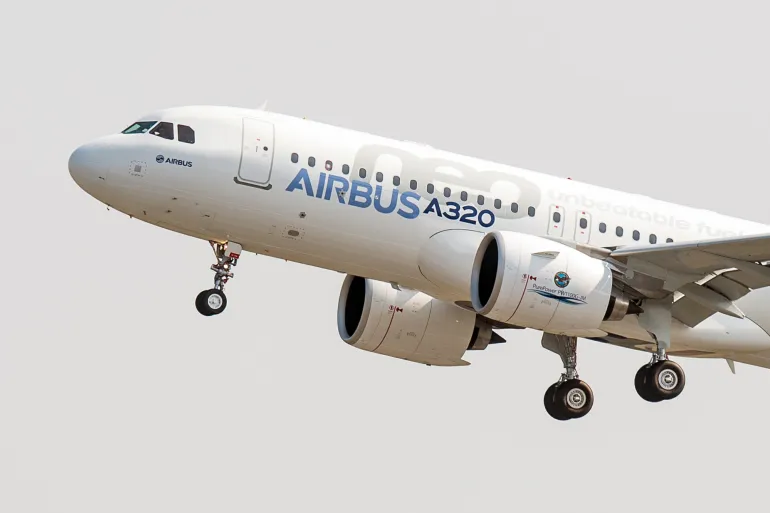
Solar Radiation Glitch Forces Grounding of 6,000 Airbus A320-Series Aircraft
Thousands of Airbus planes have been grounded after it was discovered that intense solar radiation can interfere with flight control computers, causing delays worldwide. Around 6,000 A320 aircraft are affected, about half of the European manufacturer’s global fleet, but most are expected to return to service after a quick software update.
The UK aviation regulator said there would be “some disruption and cancellations,” though the impact at airports appears limited. Airbus discovered the issue while investigating an incident in which a plane flying between the US and Mexico suddenly lost altitude in October. The JetBlue Airways flight made an emergency landing in Florida, injuring at least 15 people.
In addition to the A320, Airbus’s best-selling model, the vulnerability also affects the A318, A319, and A321. About 5,100 aircraft can be fixed with a simple software update, typically taking around three hours. However, 900 older planes require the physical replacement of onboard computers and cannot carry passengers until the work is completed. The duration depends on the availability of replacement computers.
Airbus acknowledged that this will cause “operational disruption to passengers and customers” and apologized. Aviation analyst Sally Gethin described the situation as “very unusual,” noting that passenger impact will depend on how different airlines implement the software upgrades. For example, Lufthansa may take aircraft out of service for the update, while other airlines expect minimal disruption.
Airlines Worldwide Face Delays as Software Updates and Hardware Replacements Begin
In the UK, airport disruption has so far been limited. Gatwick Airport reported “some disruption,” while Heathrow said it had not experienced cancellations. The impact varies by airline: British Airways is expected to be minimally affected, while Wizz Air and Air India are already performing updates. EasyJet said it “expects some disruption” but has “already completed the software update on many aircraft” and plans to resume full service by Saturday.

Regulators Assure Safety as EASA Issues Emergency Directive for A320 Altitude System Fix
In the US, the issue emerged during Thanksgiving weekend, one of the busiest travel periods. American Airlines reported 340 affected planes and expected “some operational delays,” but most updates would be completed by Friday or Saturday. Delta Airlines predicted only a limited impact. In Australia, budget carrier Jetstar canceled 90 flights after confirming about a third of its fleet was affected.
Tim Johnson, policy director at the UK Civil Aviation Authority, said Airbus’s notice “may unfortunately lead to some disruption, delays, or cancellations in the coming days.” He added that aviation remains “one of the safest forms of transport” due to rigorous maintenance programs, describing the mass grounding as “a very rare event.” Transport Secretary Heidi Alexander said the impact on UK airlines seems limited and emphasized that the swift identification and resolution of the issue demonstrates the high global aviation safety standards.
The problem in A320 aircraft relates to software that calculates altitude. Airbus found that at high altitudes, the data could be corrupted by intense solar radiation, causing the October incident, though it was the only occurrence of its kind.
Closing Remarks
The European Union Aviation Safety Agency (EASA) issued an emergency airworthiness directive, requiring the problem to be fixed before planes can carry passengers again. Aircraft are still allowed to perform “ferry flights” without passengers to reach maintenance facilities.
The A320 family uses a “fly-by-wire” system, meaning there is no direct mechanical link between cockpit controls and the parts that govern flight; pilot inputs are processed by the computer.